
UPHOLD PROFESSIONALISM, ETHICS AND INTEGRITY IN YOUR WORK, HEAD OF PUBLIC SERVICE TELLS STAFF IN ROADS AND TRANSPORT SECTORS
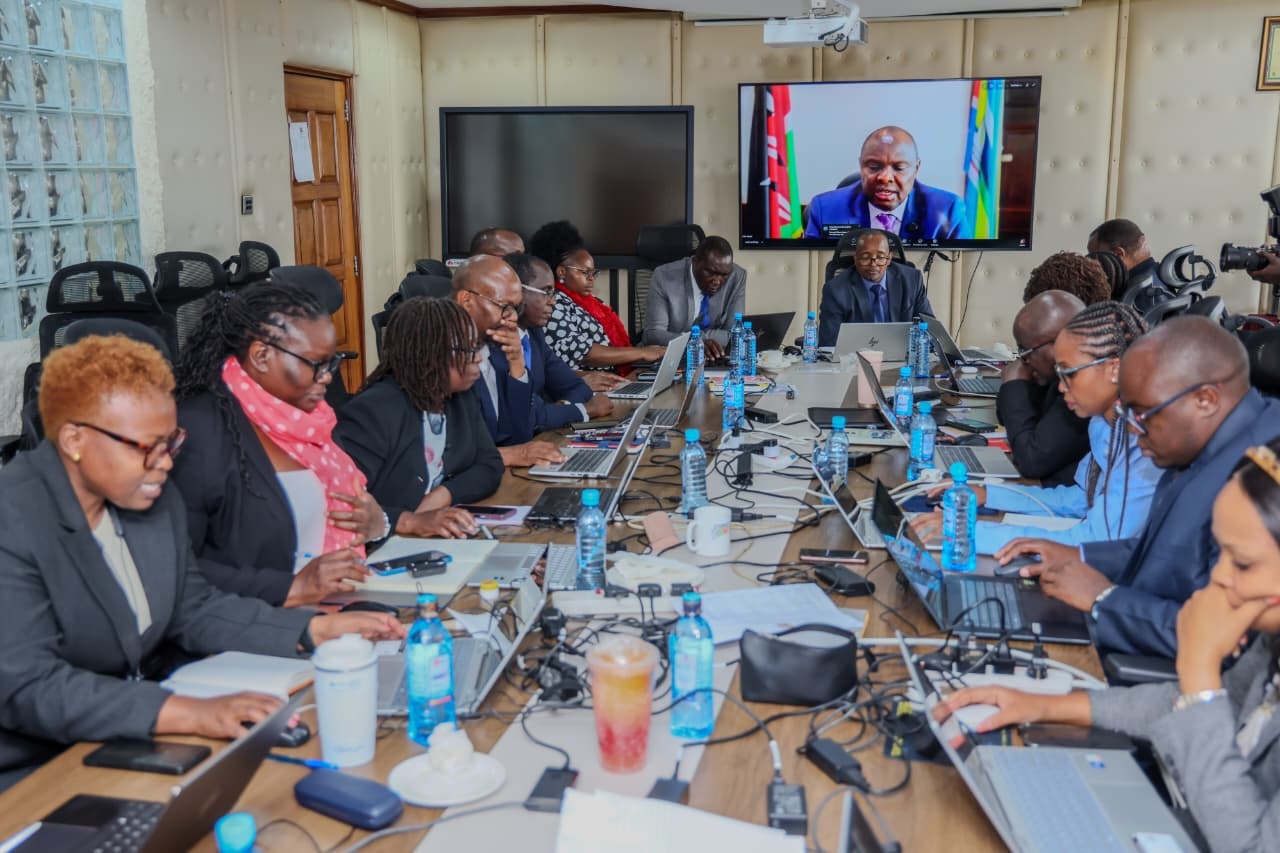
Nairobi, Kenya, 17th April, 2026: The Chief of Staff and Head of Public Service, Mr. Felix Koskei, has directed the leadership and staff of the State Departments of Roads and Transport to uphold integrity, accountability, professionalism, efficiency and responsiveness to ensure improved service delivery in the two sectors.
Mr. Koskei said that these values must be reflected in procurement, project implementation, enforcement and service delivery across the two sectors.
The Head of Public Service (HoPS) noted that roads and transport systems are not just infrastructure but rather the arteries through which economic activity flows, enabling movement of people, goods and services across the country.
“Every road constructed, every kilometre maintained, every transport system regulated, and every safety measure implemented has a direct impact on productivity, connectivity and national development,” said Mr. Koskei.
Mr. Koskei further called for mindset and attitude transformation among the staff adding that there was an urgent need to move from routine processes to results, from activity to impact.
“It is not about the number of projects initiated, but the quality, timeliness, and reliability of what is delivered.”
The HoPS, who was addressing the leadership and staff of the two State Departments during a virtual engagement, underscored the need to break down institutional silos.
“We must operate as one coordinated system. Planning, construction, maintenance, regulation, and enforcement must be aligned. Fragmentation leads to inefficiency and weakens impact,” he added.
On citizen-centred service delivery, the HoPS said that the government’s work must be felt by citizens in the form of safe roads, orderly transport systems, reduced congestion, reliable services as the standard.
Mr. Koskei emphasised the need for prudent management of public resources saying that resources must be used efficiently, transparently, and strictly for their intended purpose.
“There must be zero tolerance for wastage, inflated costs, or misuse of public funds.”
He underscored the importance of strengthening monitoring and evaluation particularly the need to track progress, monitor performance and demonstrate results.
“Kenyans want not just roads built, but roads that last. Not just systems introduced, but systems that work. Not just enforcement policies, but compliance achieved,” said the HoPS.
In remarks read on his behalf by the Secretary Administration, Mr. Evans Mutari, Roads Principal Secretary Eng.Joseph Mbugua disclosed that over the past three years, the Roads Sub-Sector had recorded steady progress in executing its mandate.
“We have expanded and upgraded to bitumen standards approximately 2,700 km of road network significantly improving connectivity across the country. This has translated into enhanced access to markets, schools, health facilities, and economic opportunities, particularly in underserved regions,” said Eng. Mbugua.
Eng. Mbugua said that several road projects have been successfully completed and commissioned across the country, marking an important milestone in improving mobility and unlocking economic potential.
“These include key urban link roads that have eased congestion in major towns, rural access roads that have opened up agricultural zones, and strategic corridors that have strengthened inter-county and regional connectivity. Collectively, these completed projects reflect tangible progress in delivering infrastructure that directly impacts the daily lives of citizens,” said the PS.
Eng. Mbugua said that notable progress had been made on flagship corridors, including the transformative Rironi–Mau Summit section of the A8 corridor, spanning approximately 175 kilometres on the Northern Corridor, which continues to advance within a structured implementation framework aimed at timely delivery and high-quality standards.
“In addition, the Horn of Africa Gateway Development Project, covering approximately 750 kilometres along the Isiolo–Wajir–Mandera corridor, is steadily progressing and is set to open up Northern Kenya, strengthen regional connectivity to the Horn of Africa, and unlock significant trade, investment, and socio-economic opportunities for the country and the wider region,” he added.
The PS revealed that the State Department was implementing an expanded programme targeting approximately 28,000 kilometres of roads to bitumen standards and dual 2,500km in the next 10 years.
Eng. Mbugua said that the sector has also embraced digital transformation as a key enabler of efficiency and accountability.
“The deployment of Intelligent Transport Systems has improved traffic management and operational monitoring, while the digitization of weighbridge operations has significantly strengthened axle load control, improved compliance, and safeguarded road infrastructure,” he said.
On his part, Transport PS Mohamed Daghar said that significant strides have been achieved in strengthening Kenya’s position as a regional transport and logistics hub.
“These include the ongoing development of the Standard Gauge Railway from Naivasha to Kisumu and Malaba, launched in March 2026, the expansion and modernisation of MGR and commuter rail services including, Nairobi-Ruiru- Thika line; Nairobi-Kikuyu-Limuru; the new Riruta- Ngong-Kiserian-Rongai line; the Miritini SGR Station to Mombasa CBD Line; and Voi-Taveta MGR line which was launched recently,” said Mr. Daghar.
Mr. Daghar said that to optimise the use of the Inland Container Depots, the Government has invested in additional SGR and MGR rolling stock to facilitate movement of cargo including perishable goods as well as enhancing efficiency and decongesting the port of Mombasa.
The PS said disclosed that the modernisation of the port of Mombasa has enabled handling of more than 45 million Metric tons in 2025 from 40million metric tons in 2024 recording a 10% increase.
“At the same time, the port recorded a through put of over 2.11million TEUs in 2025 against 2million in 2024 translating into a growth of 5.5%. The Construction of the first berth at the Dongo Kundu Special Economic Zone, which is expected to be completed by May 2028 has already started,” he said.
Mr. Daghar revealed that the Port of Lamu was now actively handling transshipment business in East Africa and positioning itself as a strategic transshipment port attracting major shipping lines.
“The Port has experienced a surge in activity in 2026, with tripled vessel traffic since early 2025 and targets to handle 1.2 million TEUs by 2027,” he added.
Mr. Daghar said that the government was continuing with the development of the Lamu Port South Sudan Ethiopia Transit (LAPSSET) Corridor, which comprises of the 500-metre corridor to accommodate the core transport infrastructure including Railway, Highway, Pipeline and Fibre Optic Cable and other utilities.
“The corridor includes 5km of commercial and logistics hubs on either side of the Corridor whose development will be actualised in an integrated and coordinated approach to achieve sustainability, optimality and viability under an Integrated Economic Corridor Development Model,” he said.
“We have also made progress in enhancing road safety through the establishment of modern motor vehicle inspection and driver testing Centres with modernization of Thika and Likoni Motor Vehicle Inspection Centres nearing completion’” said the PS.
“In addition, the State Department has also developed and launched the National E-mobility Policy in an effort geared towards greening the sector and encouraging use of green energy in transportation.”
Present at the meeting were Board Members and Staff from the two State Departments and Agencies under them.